
Musk is a strange ingredient in the world of fragrance. It is difficult to define and even harder to do without. You struggle to describe its smell in isolation because it does not announce itself, it completes everything around it. It is what makes a fragrance stay, what gives it the quiet warmth that makes a scent feel like part of the person wearing it rather than something applied from the outside.
Musk Through History
Before it was a component in a fragrance bottle, musk was, in certain periods of history, more valuable than gold. Traditionally extracted from the gland of the musk deer, a rare animal living in the high altitudes of Asia, even small quantities commanded enormous prices. It travelled through trade routes into the Arabian Peninsula, Persia, and eventually Europe, becoming a foundational element in oriental fragrances whose history stretches back centuries.
In the modern world, the use of animal musk is either banned or severely restricted due to animal welfare considerations, and it has been replaced by various synthetic and plant-derived musk types developed by contemporary perfume chemistry.
Types of Musk in Modern Fragrance
- White musk is the most widely used in contemporary perfumery. Clean, soft, skin-close, it gives a sense of freshness and gentleness without dominating the composition. People are drawn to it because it does not overshadow the fragrance but completes it, adding a softness that makes the whole thing feel natural on the skin. Candy Musk from Almajed 4 Oud is a clear example of white musk handled at its finest.
- Oriental or dark musk carries more depth and warmth than white musk. It has a noticeable weight and gives fragrances a sensual quality. It is frequently used in the base because it grounds the composition and extends longevity significantly.
- Natural Musk: Historically derived from the musk deer, natural musk is one of the rarest and most valuable fragrance ingredients. Today, its use is extremely limited due to environmental conservation and ethical concerns.
- Synthetic Musk: Created in laboratories to replicate the scent and performance of natural musk, synthetic musk is widely used in modern perfumery for its consistency, longevity, and sustainable production.
How Musk Works in a Fragrance Composition
Musk is not added to a fragrance to be a prominent note, it is added to be the frame that holds everything else in place. It typically sits in the base, arriving last in the fragrance's development on the skin and staying longest. It anchors the other notes and slows their evaporation, adding a quiet warmth that makes the fragrance seem to belong to the skin rather than sit on top of it.
In Almajed 4 Oud's fragrances, musk plays different roles depending on the composition. In Serious, it settles at the base to anchor the modern woody character. In Rannan, it harmonises with vanilla in a warm base that gives the fragrance its lasting presence. In Candy Musk, musk becomes the main personality rather than a background component, the point of the whole composition rather than its support.
Pure Musk: The Ingredient in Its Purest Form
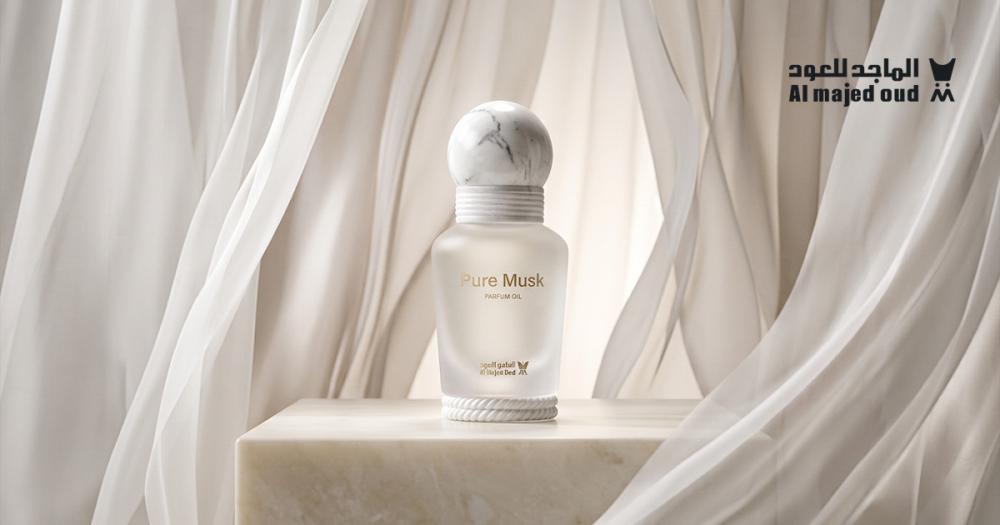
Pure Musk from Almajed 4 Oud is for those who want to understand musk outside the context of a complex composition. A concentrated perfume oil that presents musk with no added complexity to distract from it. The result is a scent that seems to emerge from the skin itself rather than from a bottle. This is the cleanest expression of everything described above.
Musk is an ingredient that resists definition because it cannot be fully understood away from the skin that it touches. Try it alone in Pure Musk, then try it as part of a layered composition in Serious or Rannan, and in both cases you will understand why no sophisticated fragrance formula has ever managed to do without it.
